


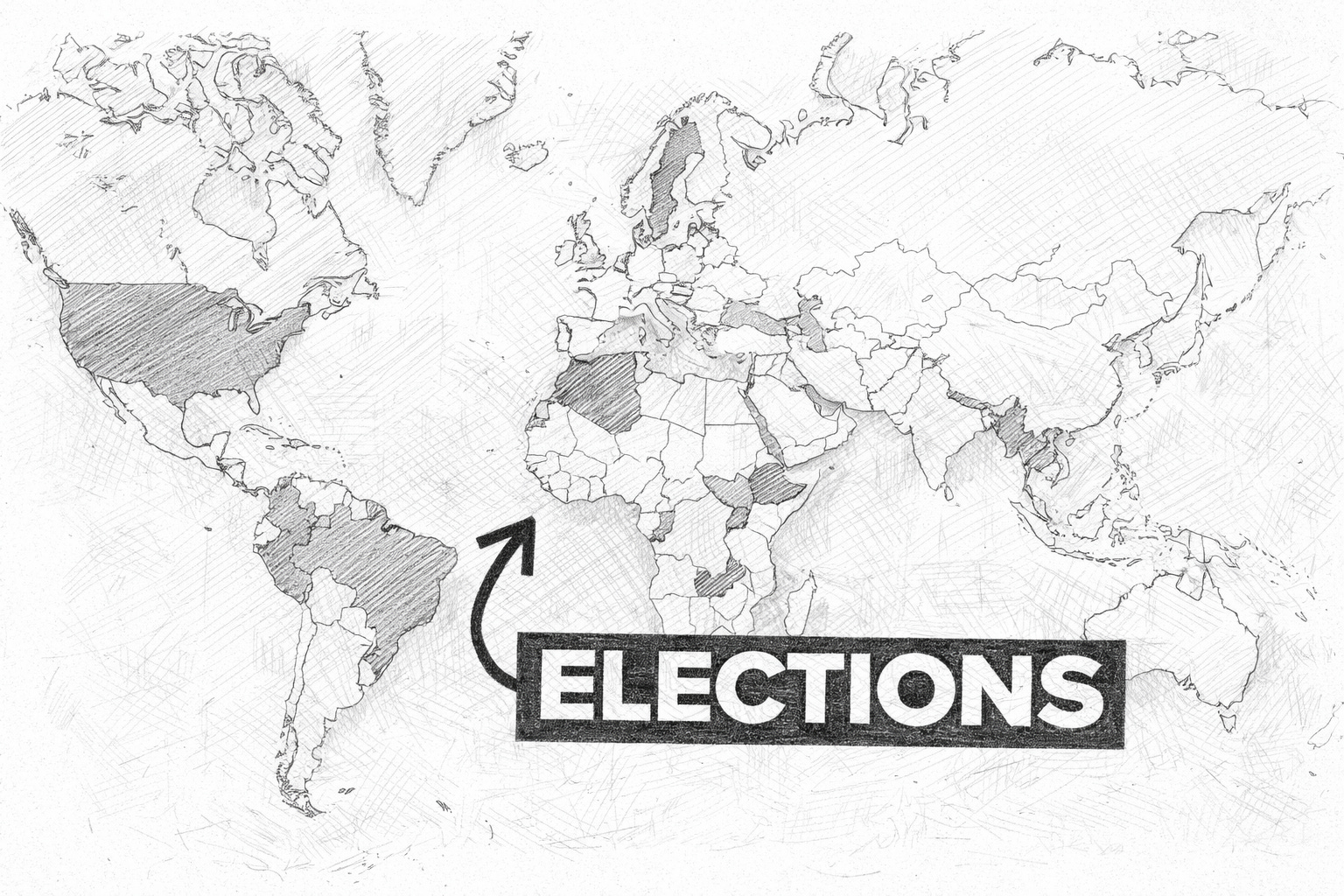
The year 2026 is shaping up to be another major election year across the globe. Two years ago in 2024 there were no less than 60 elections held across the world with a cumulative population of nearly 4.2 billion who participated in elections. And 2024 was indeed a consequential election year all over the globe. At home we witnessed our own seismic election change with the ANC’s three-decade dominance finally broken, thrusting us into an era of coalitions.
From Washington DC to Wellington, voters are clamoring for change, testing the strength of democracies and the appeal of dissentient politics. All these elections may be happening oceans away, but their outcomes will have an effect on South Africa’s economy, security, and even our political imagination.
US Midterms
Take the United States midterm elections due to be held in November 2026. Midterms in the US normally get less fanfare than a US presidential race, but this one could be momentous. After the shake up of the 2024 U.S. vote, America is under the leadership of President Donald Trump once again with all the expected fireworks. With narrow Republican majorities in Congress enabling Trump’s agenda, the midterms will determine if his grip on power tightens or slips. Should Democrats seize control of even one chamber, it would slam the brakes on Trump’s legislative plans and flood Washington with oversight investigations (as was seen during Trump’s first term).
For a White House that thrives on projecting strength, that kind of check could be a major blow. Conversely, if Republicans hold on, Trump would feel emboldened, and will no doubt double down on the vigorous policy agenda that has defined his second term.
The election of Zohran Mamdani as Mayor of New York City, a self-described democratic socialist of Ugandan-Indian descent, has shaken the political establishment. His rise hints at a growing appeal of left-progressive politics that focuses less on identity politics and more on economic issues like affordability and housing. Mamdani’s election along with the two gubernatorial Democratic victories in Virginia and New Jersey could signal a broader shift or backlash depending on how these midterms go.
This will also gauge how Americans view their political extremes. While the MAGA movement and the democratic socialist left are often cast as polar opposites, there are signs that voters perceive them as sharing a common scepticism of elite institutions, entrenched interests, and the political status quo. In this sense, the midterms may also reveal how deep and how wide the country’s appetite is for anti-establishment politics, irrespective of ideological flavour.
Given that South Africa has certainly faced the Trump administration’s headwinds, the outcome of these midterm elections, taking place nearly simultaneously with our own local government elections, will be of local consequence.
Brazil
Shift to South America, where Brazil’s general election in October 2026 might turn out to be historic. On one side stands Luiz Inácio “Lula” da Silva, the leftist incumbent who has been a leading voice for the developing world and a partner in forums like BRICS. Lula has been particularly vocal in taking a stand against the Trump administration. He is seeking his fourth term.
On the other side a new standard-bearer of Brazil’s right wing has emerged: Senator Flávio Bolsonaro – yes, the son of Jair Bolsonaro, the former president now jailed for plotting a coup after refusing to accept his 2022 defeat. With Jair Bolsonaro barred from politics and serving a 27-year sentence, his family legacy and politics lives on in Flávio’s candidacy. Early polls indicate a deeply divided electorate, with Lula maintaining an edge in urban and working-class strongholds, while Flávio Bolsonaro draws fervent support from rural regions, evangelical communities, and a growing online youth base disillusioned with traditional politics.
For Brazilians, this election is a showdown over the direction of their democracy after a period of intense polarisation. For the world, Brazil’s choice will influence the global climate change approach, the unity of the BRICS bloc, and the momentum of the Latin American leftward shift. We’ll be watching to see whether Brazil reaffirms the progressive, multilateral path charted by Lula, or pivots back toward the nationalist, anti-establishment politics associated with the Bolsonaro era.
United Kingdom
In the United Kingdom 2026 will bring crucial elections in the nations of the union, Scotland and Wales. Britain’s politics since Brexit have been stormy, and by 2026 the turmoil will likely extend beyond Westminster. In Scotland and Wales, voters will elect their devolved governments in what promises to be a dramatic departure from the old order. In Wales, the once-invincible Labour Party (which has governed for a century) is watching its support crumble. Polls put the pro-independence Plaid Cymru and Nigel Farage’s right-wing Reform UK neck-and-neck at around 30% each, while Labour has plunged to barely 14%. Plaid Cymru’s leader has framed the contest as a two-horse race between “vision and division,” casting Reform UK’s rise as part of a broader global wave of anti-establishment politics. Meanwhile, Reform UK continues to gain ground, buoyed by growing support among blue-collar voters and a widening dissatisfaction with traditional parties.
A similar dynamic is playing out in Scotland, where the Scottish National Party (SNP) remains ahead but is no longer unassailable. After years of dominance, the SNP now finds itself navigating voter fatigue, internal fractures, and a more competitive political field. Remarkably, Reform UK has gained traction north of the country, an area once seen as inhospitable to its brand of politics. By tapping into unionist disillusionment and anti-establishment sentiment, it is drawing voters away from the once-dominant Conservative Party and the SNP. This shift signals a broader erosion of traditional party loyalties, as more Scots, unionist and nationalist alike, seek alternatives to the status quo in an increasingly fragmented landscape.
Hungary
Meanwhile, on the European mainland, Hungary is set to have parliamentary elections. Hungary in 2026 could mark a pivotal chapter in the global reckoning with establishment politics and the rejection of entrenched elites and political stagnation.
Prime Minister Viktor Orbán has ruled for 15 years, advancing a model of governance he describes as “illiberal democracy”, one that has centralised power and often placed Hungary at odds with mainstream European Union positions. Yet for the first time in over a decade, Orbán faces a serious challenge at the ballot box. A new, centre-right opposition party called Tisza, led by former Orbán ally Péter Magyar, has surged in the polls by tapping into frustration over corruption and advocating for closer alignment with the EU.
A renewed Orbán mandate would affirm a broader political trend that questions traditional liberal institutions and champions national control over supranational influence. But a Tisza victory could signal a public appetite in the central European country for reform and reconnection with Brussels, potentially reshaping EU debates on everything from Russian sanctions to migration.
Israel
By law, Israel must hold a general election by October 2026, and barring surprises it will be a referendum on the era of Benjamin Netanyahu. As of late 2025, Netanyahu, a consummate political survivor, has been in power almost continuously since 2009, a tenure so long that many Israelis voting for the first time have known no other leader.
A divisive judicial overhaul that sent hundreds of thousands of protesters into the streets, then the war in 2023 in response to the Hamas attack on 7 October that shattered Israelis’ sense of security, and an emergency unity government that brought opposition figures into the fold temporarily, all form the backdrop of the election.
Netanyahu’s base seems still persuaded by his message that only he can keep Israel safe, a narrative he’s pushing even harder after claiming victory in a brutal conflict and a successful campaign against enemies like Hamas and Hezbollah. On the other side, a broad swath of Israelis are demanding political accountability and national unity after the October 7 trauma.
There’s talk of a new “Zionist alliance” – an unprecedented coalition of centrists, moderates, perhaps even former rivals united by one goal: unseating Bibi.
The outcome of the election could determine the fate of any future peace negotiations with Palestinians. It will also signal whether Israel’s democracy can withstand the strain of internal upheaval and the massive international pressure the country has faced following the Gaza conflict. Moreover, the result of the election will undoubtedly influence how ongoing talks between the US and Middle Eastern nations evolve, particularly around normalisation deals, regional security frameworks, and the future of a two-state solution, issues with global resonance, including here in South Africa.
New Zealand
And then there’s New Zealand, holding elections in late 2026. This small island nation often feels like a world apart, but its political currents are part of the same global tide. New Zealand’s last election, in 2023, swept out Jacinda Ardern’s progressive Labour Party and ushered in a coalition of the conservative National Party with two smaller allies – the right-leaning ACT Party and New Zealand First, often described as populist for its blunt rejection of establishment orthodoxy. It was a striking turnaround for a country that, just a few years earlier, was globally admired for Ardern’s progressivism.
By 2026, Kiwi voters will be assessing whether this three-party arrangement delivered the “reset” many hoped for. The new government in Wellington has had to navigate the ideological tug-of-war between a libertarian economic agenda and nationalist social policy, all while facing mounting economic headwinds. Cost-of-living pressures remain acute, housing unaffordability is still widespread, and a growing number of New Zealanders have begun migrating across the Tasman Sea to Australia in search of better pay and opportunities, a trend that speaks volumes about public frustration with stagnant prospects at home.
Voters there were not necessarily endorsing any single ideology, but rather expressing impatience with the political status quo, inflation, and a sense that Labour had grown out of touch. The coalition they elected was as much about shaking things up as it was about any unified vision.
Other elections
Beyond the headline races, several other countries will face pivotal moments in 2026.
In Nepal, the political landscape remains unsettled following the “Gen Z revolution” that toppled the previous government. This year’s elections will be the first since that uprising, with a surge of youth-led parties challenging a political class long dominated by dynastic elites and their “nepo kids.” Public frustration over corruption, the soaring cost of living, and a stagnant economy has made political renewal in the country urgent.
In Colombia, voters will decide whether to continue the leftward shift begun under President Petro (who is ineligible for another term) or revert to conservative rule, all happening within a very crowded field of parties. Armenia heads to the polls under intense geopolitical pressure, with Prime Minister Pashinyan’s West-facing agenda clashing with resurgent pro-Russian sentiment. Uganda’s “election”, likely to hand 80-year-old President Museveni another term, highlights the continent’s ongoing struggle with entrenched leadership and democratic erosion. In Bangladesh, a post-revolution vote could mark the revival of democracy after years of authoritarian rule. And in Thailand, still reeling from the judicial ouster of its most popular party, democratic hopes hinge on whether the military-backed establishment loosens its grip.
Conclusion
Looking across this global map of elections it’s quite clear that voters are demanding accountability, some turning to reformers, others to disruptors. What’s often called “populism” may, in many cases, reflect a reasonable impatience with disconnected institutions. Long-standing incumbents are being challenged, coalitions are becoming the rule rather than the exception, and electoral volatility is testing traditional politics.
While it might not suit the established order, this turbulence signals a new political era—less defined by left vs. right, and more by trust vs. mistrust. In this post-progressive era, voters are rewriting the rules of engagement, demanding not just promises, but proof of relevance and responsiveness.
More articles:


If you found this piece worthwhile, feel free to share it with someone who might appreciate it.
To get future essays delivered directly to your inbox, you can subscribe here:
I welcome thoughtful conversation—feel free to reach out on LinkedIn or follow along on Twitter.
An edited version of this article was published on The Daily Friend. If you'd like to support my writing please subscribe and consider a pledge.
This cover image was created using Sora.